What are examples of paramagnetic materials?
Paramagnetic Materials: These are
metals that are weakly attracted to magnets. They include aluminum, gold, and copper. The atoms of these
substances contain electrons most of which spin in the same direction but not all . This gives the atoms
some polarity.
What are the paramagnetic elements?
Iron oxide, FeO, has a very high value of 720. Other materials considered strongly
paramagnetic include iron ammonium alum (66), uranium (40), platinum (26), tungsten (6.8), cesium (5.1), aluminum (2.2), lithium (1.4) and magnesium (1.2), sodium (0.72) and oxygen gas (0.19).
Is o2 − paramagnetic?
Oxygen is
paramagnetic mainly because it consists of two unpaired electrons in its last molecular orbital. This can be proven if we look at the molecular orbital diagram of
oxygen.
How do you know if an element is paramagnetic or diamagnetic?
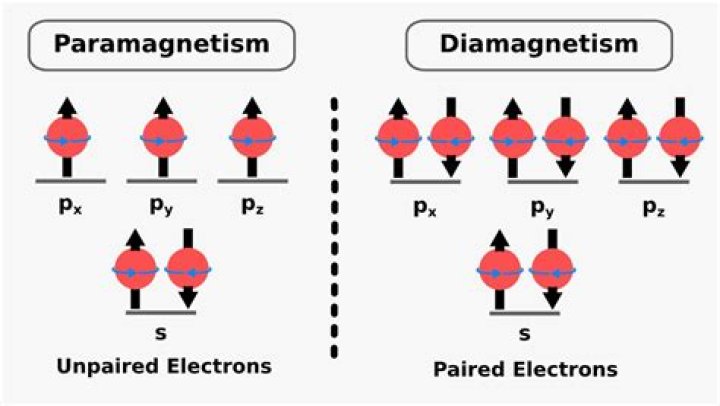
The magnetic properties of a substance can be determined by examining its electron configuration:
If it has unpaired electrons, then the substance is
paramagnetic and
if all electrons are paired, the substance is then
diamagnetic.
Which of the following is a paramagnetic?
Step by step solution by experts to help you in doubt clearance & scoring excellent marks in exams.
Paramagnetic species contains unpaired electrons in their molecular orbital electronic configuration. Thus, among the given species only O-2 is
paramagnetic.
Is Cu+ paramagnetic or diamagnetic?
Since the
Cu+ ion has no unpaired electrons, hence it is
diamagnetic.
Is Iron diamagnetic or paramagnetic?
Compounds in which all of the electrons are paired are
diamagnetic.
6.3 Paramagnetic Properties of Fe, Fe2+ and Fe. 3+
| Sample | Paramagnetic? |
|---|
| Iron(III) | Paramagnetic (1 lone electron). |
| Salt | Diamagnetic. |
| Sugar | Diamagnetic. |
| Water | Diamagnetic. |
Which is more paramagnetic Cu+ or cu2+?
The d-And-f-Block Elements. Explain why
Cu(I) is
diamagnetic and Copper(II) is
paramagnetic. In
Cu+ the electronic configuration is 3d
10 completely filled d- shell thus it is
diamagnetic. thus it has one unpaired electron in d- subshell thus it is
paramagnetic.
What is diamagnetic Behaviour?
Whenever two electrons are paired together in an orbital, or their total spin is 0, they are
diamagnetic electrons.
Diamagnetic atoms repel magnetic fields. The unpaired electrons of paramagnetic atoms realign in response to external magnetic fields and are therefore attracted.
Why diamagnetism is a universal phenomenon?
Diamagnetism is a universal property of the atom since it arises from the motion of electrons in their orbits around the nucleus. Electrons moving in this way represent electrical circuits and it follows from Lenz’s law that this motion is altered by an applied field in such a manner as to set up a repulsive force.
What is antiferromagnetic material?
The
materials that exhibit the
antiferromagnetism are known as
antiferromagnetic material. Hematite, chromium, alloys of iron manganese and oxides of nickel are the examples of
antiferromagnetic material.
Are superconductors diamagnetic?
Diamagnetism is due to currents induced in atomic orbitals by an applied magnetic field.
Superconductors take the
diamagnetic effect to the extreme, since in a
superconductor the field B is zero – the field is completely screened from the interior of the material.
What is type1 and type 2 superconductor?
A
type I
superconductor keeps out the whole magnetic field until a critical app- lied field Hc reached. A
type II superconductor will only keep the whole magnetic field out until a first critical field Hc1 is reached. Then vortices start to appear. A vortex is a magnetic flux quantum that penetrates the
superconductor.
Do Superconductors have zero resistance?
Superconductors are materials that carry electrical current with exactly
zero electrical
resistance. This means you can move electrons through it without losing any energy to heat.
What material is a superconductor?
Superconductor material classes include chemical elements (e.g. mercury or lead), alloys (such as niobium–titanium, germanium–niobium, and niobium nitride), ceramics (YBCO and magnesium diboride),
superconducting pnictides (like fluorine-doped LaOFeAs) or organic
superconductors (fullerenes and carbon nanotubes; though
Is gold a superconductor?
Gold itself does not become a
superconductor – above the millidegree range even if it is extremely pure, while none of the
gold-rich solid solutions so far studied have proved to be
superconducting.
Is ceramic a superconductor?
For example, it can be cooled with liquid helium, which works at much lower temperatures. Many
ceramic superconductors physically behave as
superconductors of the second type.
What is called superconductor?
Superconductors are materials that conduct electricity with no resistance. This means that, unlike the more familiar conductors such as copper or steel, a
superconductor can carry a current indefinitely without losing any energy.